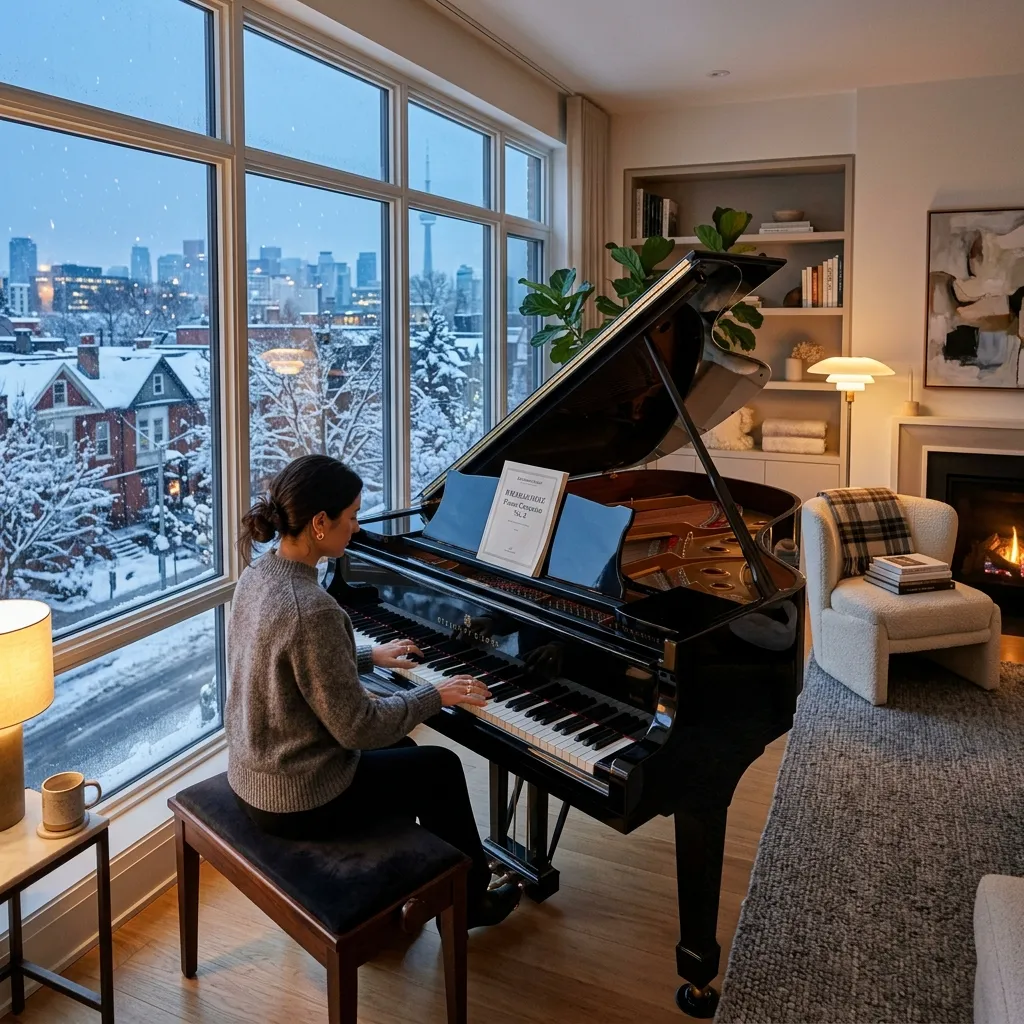
Understanding the Winter Pitch Drop in Toronto
If you've owned a piano in the Greater Toronto Area for more than a year, you've likely noticed a frustrating but familiar pattern: as soon as the snow begins to fall and the central heating turns on, your piano's glorious resonance begins to falter. The chords lose their brightness, unisons begin to wobble, and the entire instrument seems to sound progressively flatter. You are not alone. Countless Toronto piano owners face this very same dilemma every winter season.
The root cause of this seasonal instability lies not in the quality of the piano itself, but in the dramatic climatic shifts that define our Canadian environment. In this comprehensive guide, we will explore the underlying physics of why a piano's pitch drops during cold, dry months, how the change impacts the internal components of your instrument, and the most effective strategies to mitigate these effects and protect your musical investment.
The Living Organism Inside Your Piano: The Soundboard
To truly grasp the mechanics of tuning instability, one must look at the heart of the instrument: the soundboard. The soundboard is a large, thin sheet of wood - typically crafted from fine-grained spruce - that acts as the amplifier for the strings' vibrations. It is not flat; rather, it is designed with a slight upward curve, known as a "crown," which presses against the strings through the bridges.
Wood is a hygroscopic material, meaning it constantly absorbs and releases moisture in response to its surrounding environment. In the humid summer months of Toronto, the spruce soundboard drinks in moisture from the heavy, sticky air. This absorption causes the wood cells to swell, increasing the upward curve of the crown. As the crown rises, it pushes the bridges more firmly into the strings, increasing their tension. The result— The piano's pitch goes noticeably sharp.
Conversely, the onset of winter brings a sharp drop in outdoor humidity, a condition aggressively exacerbated by the use of indoor central heating. Furnaces dry out the indoor air to extreme levels. In this arid environment, the soundboard rapidly loses moisture and begins to shrink. The crown flattens out, moving away from the strings. This relaxation of pressure reduces the overall string tension, and consequently, the pitch of the entire piano drops flat.
The Disproportionate Effects of Winter Drying
If a piano dropped perfectly in pitch across all 88 keys, it might simply sound slightly transposed. However, because the soundboard is a complex piece of engineering with varying thickness, ribs, and bridging, it expands and contracts unevenly. The middle section - where the soundboard is widest and most responsive - tends to move the most. As a result, the unisons (the two or three strings tuned to the same pitch for a single note) drift apart at different rates.
This uneven movement is what creates the "sour" or "honky-tonk" sound that drives musicians crazy. When a piano is subjected to these severe seasonal swings without regular service, the overall drop in pitch can exceed 10 to 20 cents (a cent being 1/100th of a semitone). In some practice rooms where humidity goes completely unmonitored, technicians have documented pitch drops of up to 30 cents during the coldest parts of the year!
If left unaddressed for several seasons, the drop becomes so significant that a simple tuning is no longer sufficient. A technician will have to perform a "pitch raise" (or pitch correction) - a stressful and time-consuming procedure that involves rough-tuning the entire piano to significantly higher tension before performing a fine tuning. Regular servicing is a much safer, more stable, and more cost-effective approach.
Long-Term Consequences: Why Winter Dryness is Dangerous
A dropping pitch is not merely an auditory annoyance; it is a vital warning sign that the piano is undergoing structural stress. Extreme dryness doesn't just flatten the soundboard; it puts the entire wooden anatomy of the piano at risk.
Soundboard Cracks: When the spruce shrinks aggressively, the tension across the wood can become too great, resulting in long stress cracks running parallel to the grain. While a cracked soundboard doesn't immediately spell the death of a piano, it can lead to buzzing, loss of resonance, and a decrease in the instrument's overall value.
Pinblock Failure: The pinblock is a multi-laminated block of hard maple that holds the steel tuning pins tight against the pull of the strings. If the pinblock dries out excessively over many winters, the wood fibers shrink and lose their grip on the metal pins. When this happens, the piano literally cannot be tuned - the pins simply slide backward under the tension. Repairing or replacing a pinblock is an incredibly expensive overhaul.
Action Looseness: The intricate mechanical action of a piano contains thousands of tiny wooden, felt, and leather parts. Dryness causes these parts to shrink, which can lead to loose screws, clicking keys, wobbling hammers, and an uneven, unresponsive touch.
How to Protect Your Piano During a Toronto Winter
While we cannot control the weather outside, there are several highly effective ways to manage the microclimate inside your home and keep your piano happy, healthy, and in tune.
1. Monitor Your Indoor Humidity
The first step in defense is knowledge. Purchase a reliable digital hygrometer and place it on or near your piano. The ideal relative humidity for a piano is between 40% and 50%. In Toronto, winter indoor humidity can easily plunge to 20% or lower if unmanaged. By keeping a close eye on the hygrometer, you will know exactly when you need to introduce moisture to the room.
2. Utilize Room Humidifiers
If you don't have a whole-home humidification system attached to your furnace, a dedicated room humidifier is essential. An evaporative humidifier works best for large spaces. Keep it running consistently throughout the winter to counteract the drying effects of your heating system. Note that you should never point the humidifier directly at the piano; simply maintaining the room's ambient humidity is sufficient.
3. Consider a Dedicated Piano Climate Control System
For ultimate peace of mind, many professional technicians recommend installing a piano climate control system, such as a Dampp-Chaser. This system is installed completely out of sight inside the piano (or underneath the soundboard of a grand). It features a humidistat that constantly monitors the microclimate. When it detects dryness, it activates a small humidifier to gently introduce moisture. When it detects excess humidity, it activates a low-wattage dehumidifier rod to dry the air. Because it treats the air immediately surrounding the soundboard, it is highly efficient and remarkably effective at preserving tuning stability.
4. Mind Your Placement
Never situate your piano near a heat source. Keep it far away from radiators, baseboard heaters, forced-air vents, and fireplaces. Direct heat will rapidly bake the moisture out of the wood, causing catastrophic damage in a remarkably short period. Additionally, avoid placing the piano near drafty windows or frequently opened exterior doors where sudden blasts of frigid air can shock the instrument.
5. Maintain a Regular Tuning Schedule
A piano is an organic, living instrument that requires consistent care. Even with perfect climate control, strings will naturally stretch and parts will settle. To maintain a beautiful, stable tone and avoid the need for dramatic pitch raises, schedule a professional tuning at least twice a year - ideally in the mid-fall after the heat turns on, and in the mid-spring when the heat turns off. This routine ensures that the tension within the instrument remains balanced, preventing structural fatigue and maximizing the life of the piano.
Conclusion
Toronto winters are undeniably tough, but they don't have to take a toll on your beloved instrument. By understanding the profound impact of humidity changes, implementing proactive climate control measures, and committing to regular professional maintenance, you can enjoy a beautifully in-tune piano regardless of how cold it gets outside. Protect your investment, and your piano will reward you with decades of glorious music.